Artificial intelligence adoption in health care delivery
December 5, 2025

Summary: Artificial intelligence adoption in hospitals is likely high, which raises AI adoption in health care delivery overall. AI adoption could improve the scale and quality of health care delivery, but might not decrease total medical expense.
Trends in Artificial Intelligence (AI) Use in Health Care vs Non–Health Care Sectors
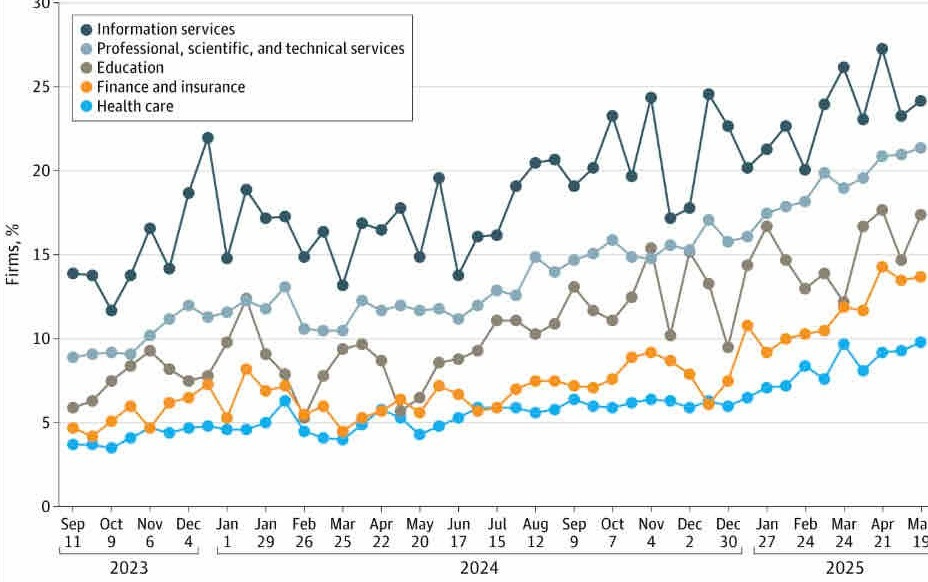
Source: Nguyen, et al JAMA Health Forum November 21, 2025
Some have projected that adoption of artificial intelligence will lower health care costs by 5-10%, and have proposed that effective use of artificial intelligence could decrease waste and low value care. Others see an “arms race” between providers and payers, where providers deploy AI to raise revenue collection while payers use AI to downcode services.
Nguyen et al use data from a survey of businesses conducted biweekly by the U.S. Census Department to address where we are now. They report that the health care industry lags in self-reported use of AI compared to other information-heavy industries, including finance, education, professional services, and information services.
But I’m not sure that this is the right conclusion. The Census Bureau lumps together medical care with nursing home and other residential care, which has adopted AI much more slowly. Also, the Census Bureau has not reported on hospital survey responses because there were too few responses to maintain confidentiality. Hospitals are at the center of the adoption of AI, with large information technology infrastructure and investments. Reporting on health care use of AI without hospitals is like reporting on AI use at a giant retailer by surveying store managers and not those in charge of logistics and inventory.
AI adoption in health care is likely to continue to increase substantially. Practicing clinicians are eagerly using AI to decrease the burden of visit documentation. Use of AI to provide information to clinicians to help improve diagnosis and to interpret patterns in images and labs could genuinely improve the quality of care and prevent errors. And yes, we’ll continue to see the arms race of providers using AI to increase revenue capture, and plans using AI to downcode and detect questionable charges.
Implications for employers:
AI adoption in health care is likely happening more quickly than this research suggests.
AI adoption can improve the quality of care and can increase access, but insurers and employers should be vigilant about the potential for increased coding that could lead to increased total cost of care.
AI has the potential to substantially change health care delivery over the next decade.