Fewer primary care practitioners available
January 26, 2026

Summary: New research confirms that the supply of primary care clinicians, especially physicians, has declined sharply over the past decade, making it increasingly difficult for patients to find PCPs with open panels. For employers, this shortage is likely to worsen access problems and accelerate reliance on telemedicine, on-site clinics, and care navigation services.
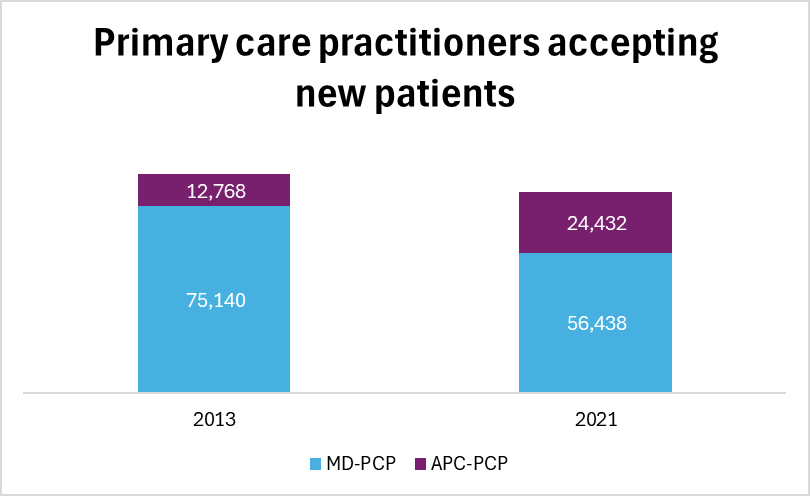
Source: Morgan KM, et al Primary Care Clinicians Available for New Patient Visits. JAMA Intern Med. January 20, 2026; MD-PCP are physician Primary Care Physicians; APC-PCP are Advanced Practice Clinician PCPs such as nurse practitioners or physician assistants.
It’s getting harder to get an appointment with a new primary care physician (PCP). Across the country, patients report waiting months for a new-patient appointment when their PCP retires or shifts to a limited practice. In many cases, practices will not refill prescriptions or address acute concerns until after that first visit. Even hospitals reportedly struggle to recruit enough PCPs for their new trainees.
Research published in JAMA Internal Medicine used traditional Medicare claims data, cross-referenced with licensure data to compare the number of primary care clinicians in 2013 and 2021. The analysis included physicians and advanced practice clinicians (APCs), such as nurse practitioners and physician assistants. Practitioners were defined as open to new patients if they saw at least 11 new patients in a calendar year.
The study found that there were 8% fewer primary care practitioners overall in 2021. The number of physician PCPs declined by 24.9%. Although the number of APCs nearly doubled, that increase was not sufficient to offset the loss of physicians. As a result, the number of PCPs per million population fell from 278 to 244—a 12% decline (based on my calculations from the paper’s data).
Because clinicians who see traditional Medicare patients also tend to see patients with commercial insurance—and prior research shows that most physicians with open practices do not exclude Medicare—these findings are likely relevant to adults enrolled in employer-sponsored health plans.
Implications for employers
Employees are increasingly struggling to find primary care physicians with open panels.
Telemedicine is likely to play a larger role as plan members are unable to secure in-person PCPs.
Employers with a large concentration of employees in one geographic area may offer on-site primary care clinics, though these are often limited to employees and not their dependents.
Employers can provide navigation services to help plan members identify and connect with high-quality PCPs.
However, the underlying issue is an inadequate supply of PCPs, and access problems will persist until that supply improves. That will likely require large- scale changes in reimbursement, policy and professional and medical education.
Jeff, this is a very thoughtful piece. Thank you. One thing I would add is that, as society evolves, and as the slow churn of established and entrenched practices and mores of how American healthcare should be delivered and paid for evolves, we can still have the hope for positive disruption. Knowing you, and your work, I know you see these potentials too. I have hope that we will manage AI for good in healthcare. I also have hope that we will recognize that not all healthcare has to be offered only by physicians, and that much care can safely (and with very high quality) be delivered by nurses and other health professionals. We can choose to expand the pie to help more Americans have access to high quality care right now if we want to.