High cost claimants drive increasing health care premiums
March 12, 2026

Summary: High-cost claimants, those with annual medical spending exceeding $100,000, are an increasing driver of employer health care cost growth.
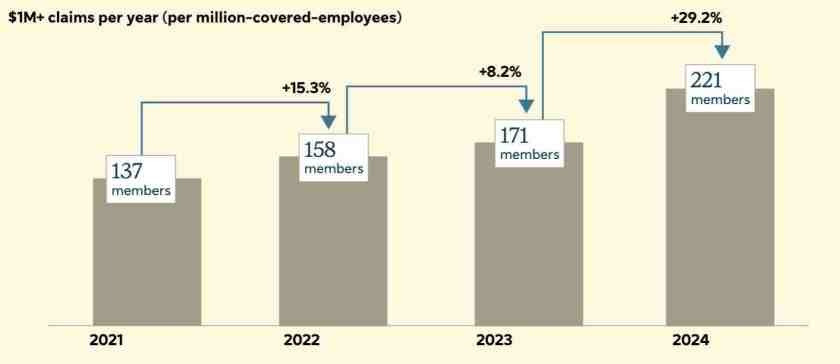
Source: High-cost claim and injectable drug trends analysis,Sun Life, 2025
Medical inflation remains high, and many employers saw double-digit premium increases in 2026. Several factors continue to push costs higher, including general inflation, medical innovation, provider consolidation, and misaligned payment incentives. Pharmacy spending continues to grow faster than overall inflation. However, new therapies have also improved outcomes. Examples include cancer therapies that improve survival, GLP-1 drugs that treat diabetes and reduce cardiometabolic risk and weight, and biologic treatments that improve outcomes for conditions such as multiple sclerosis, inflammatory bowel disease, rheumatoid arthritis, and psoriasis.
Medical costs are highly concentrated. In a population ages 18-65, 1% of the population represents 21% of costs, and 5% of the population represents 50% of costs. Many employers have found that high-cost claimants, those whose medical spending exceeds $100,000 in a year, represent a growing portion of health care cost growth.
Sun Life Insurance, a stop loss and reinsurance carrier, reports that costs of high-cost claimants increased 61% from 2021 to 2024. During this period, the largest reinsurance payouts were for solid tumors, cardiovascular disease, musculoskeletal conditions, blood cancers, and newborn care.
Some increase in high-cost claimants is expected as medical inflation pushes claims above the $100,000 stop-loss threshold. However, the recent growth in high-cost claims far exceeds what inflation alone would predict.
Implications for employers:
High-cost claimants are responsible for a substantial share of medical cost growth.
Employers can review their stop-loss and reinsurance coverage, including attachment points and premiums, given the rising impact of high-cost claims.
Some employers may also consider specialty vendors that pool risk and manage high-cost therapies, including gene and cell therapies.
Thanks for reading! Hope you’ll subscribe to this newsletter, and please hit the “like” button. Please also recommend this newsletter to friends and colleagues - it’s free. You can find previous posts at this link. Scroll down for today’s animal photo.
Views expressed in Employer Coverage are purely my own.