Prior authorization varies greatly among commercial insurers
May 21, 2026

Summary: A study of publicly available commercial health insurance provider manuals finds striking inconsistency in which procedures require prior authorization (PA) and what criteria must be met, which complicates health plan pledges to reduce PA.
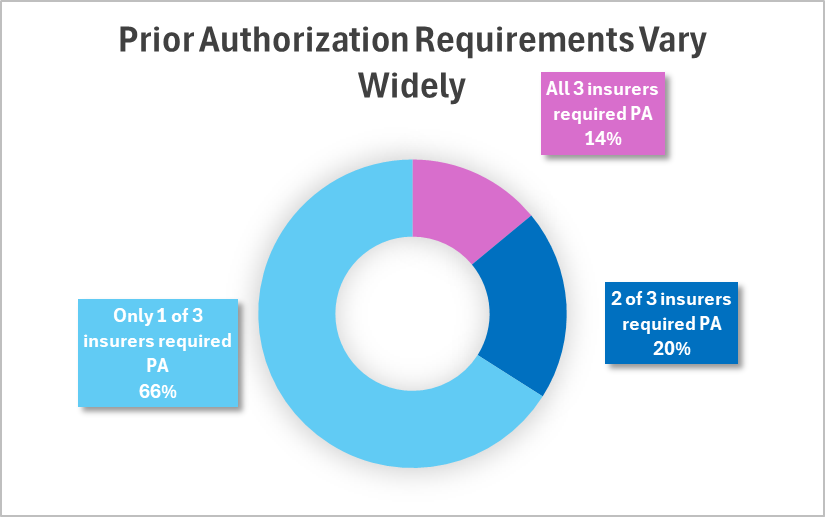
Source: Jabri, AZ et al Variation in Commercial Insurer Prior Authorization Rules Annals of Internal Medicine May 19, 2026
As scrutiny of insurer prior authorization (PA) requirements intensifies among providers and policymakers, research published this week in Annals of Internal Medicine documents substantial variation among major commercial insurers in which procedures require prior authorization and under what circumstances. Health plans have pledged to reduce their PA requirements, but this study reveals that starting points differ considerably from plan to plan
The researchers used publicly available provider manuals from Aetna, Humana and United HealthCare, and asked Chat GPT 3.5 Turbo to extract prior authorization requirements from each. They then spot checked the results to guard against AI hallucination. These findings may not generalize to other national or regional health plans, and each insurer may maintain different provider manuals for individual self-insured employer accounts.
The researchers found that most procedures were subject to prior authorization at only a single health plan; about one-third of procedures required PA at two or three health plans. For medical and surgical procedures, United HealthCare and Humana had more PA requirements than Aetna. The authors stated that “none of the insurers used the same criteria to require PA or the same requirements to obtain PA.”
Here’s a link to a previous post on health plan promises to decrease prior authorization.
Implications for employers:
Prior authorization sometimes serves an important purpose, and can prevent harm to patients and guide them toward more cost-effective sites of care.
Nonetheless, PA represents a real dissatisfier for health plan members, and increases administrative costs for practices and hospitals. It can also distract employees and delay clinically necessary care.
Employers can ask their carriers to report on denial rates and appeals success rates.
Employers should encourage carriers to focus prior authorizations on expensive procedures with the highest rates of overutilization.
Providers that consistently provide care consistent with evidence-based guidelines could be exempted from prior authorization requirements.