
Summary: Louisiana’s 2019 “subscription” contract for Hepatitis C (HCV) drug therapy, a fixed five-year fee for unlimited drug access, quadrupled the number of Medicaid patients treated and decreased new HCV diagnoses by 23%, generating $229 million in net five-year medical savings compared to fee for service access at prevailing prices.
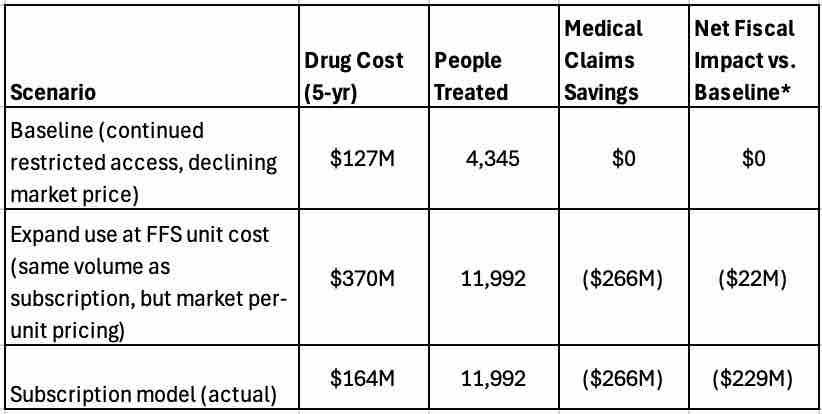
Source: Calliso, K, Spending to save: the subscription model for eradicating Hepatitis C in Louisiana, National Bureau of Economic Research, August, 2026
Hepatitis C is a deadly disease that causes substantial illness, death, and medical expense. Hepatitis C is mostly spread by exposure to blood and body fluids, usually through intravenous drug use; it can also be transmitted to a newborn during childbirth. The cause of some cases of Hepatitis C is unknown. The virus that causes it was only discovered in 1989, and highly effective drugs that cure most cases of Hepatitis C became available in 2013.
But these drugs were initially priced at $80,000-$100,000 per person. When three companies offered direct-acting antivirals (DAA)s, prices dropped to $20,000- $30,000 per person. Considering the value of a life and potential prevention of liver transplants, even the higher price was well within the boundaries of a “value based” price, but state Medicaid agencies and private insurers instituted restrictions on use so that treatment was not covered by many who could have benefited from the drugs. For instance, some Medicaid programs limited coverage to those who already had evidence of severe liver damage.
The stalemate of low adoption was bad for people with Hep C, bad for those who were at risk of exposure, and bad for Medicaid and private insurers since over time treatment was less expensive than nontreatment. This stalemate was also bad for pharmaceutical companies. The costs to manufacture DAAs are low, and drug companies were losing potential revenue and margin for each person who was not offered access to these medications.
Louisiana negotiated a “subscription” contract with Gilead pharmaceuticals where the state would pay a fixed cost for DAA medications, and Gilead would supply all the drugs needed to treat state prisoners and those on Medicaid who had Hepatitis C. The program was a success. The likelihood that a patient with newly-diagnosed Hepatitis C would be treated with a DAA within six months increased from under 20% to over 80%. Four times as many people were treated with DAA agents, and the state saw a 23% decline in new cases of Hepatitis C.
Research published as a preprint (not yet peer reviewed) by the National Bureau of Economic Research also shows that the program increased medication costs by 29%, but total medical savings (from treatment of complications and prevented new cases) were $266 million. Over five years the pharmaceutical company earned $37 million of additional revenue, and the state spent $229 million less than if they had paid the going fee-for-service rate for DAA treatment and continued to restrict drug access. This is savings in the state medical budget only, and does not include the human and economic value of lives saved.
Implications for employers:
Subscription prices could be a way to expand access to highly-effective but expensive brand name medications. The authors note that this type of pricing could be applied to gene therapy and GLP-1 medications. This approach is especially well-suited for GLP-1s, which, like DAA drugs, cost little to manufacture.
Subscription prices must incorporate guardrails so that the fixed price is reduced if market prices go down, and programs should include a robust program to encourage those eligible to get prescriptions.
Drug companies can make more revenue and margin by agreeing to subscription pricing for expensive agents that have low manufacturing costs.