Surgeons perform less low-value surgery when they are paid by salary
December 11, 2025

Summary: Surgeons in the military health system paid by salary were less likely to perform low- value surgery than surgeons in the private sector who were paid fee for service.
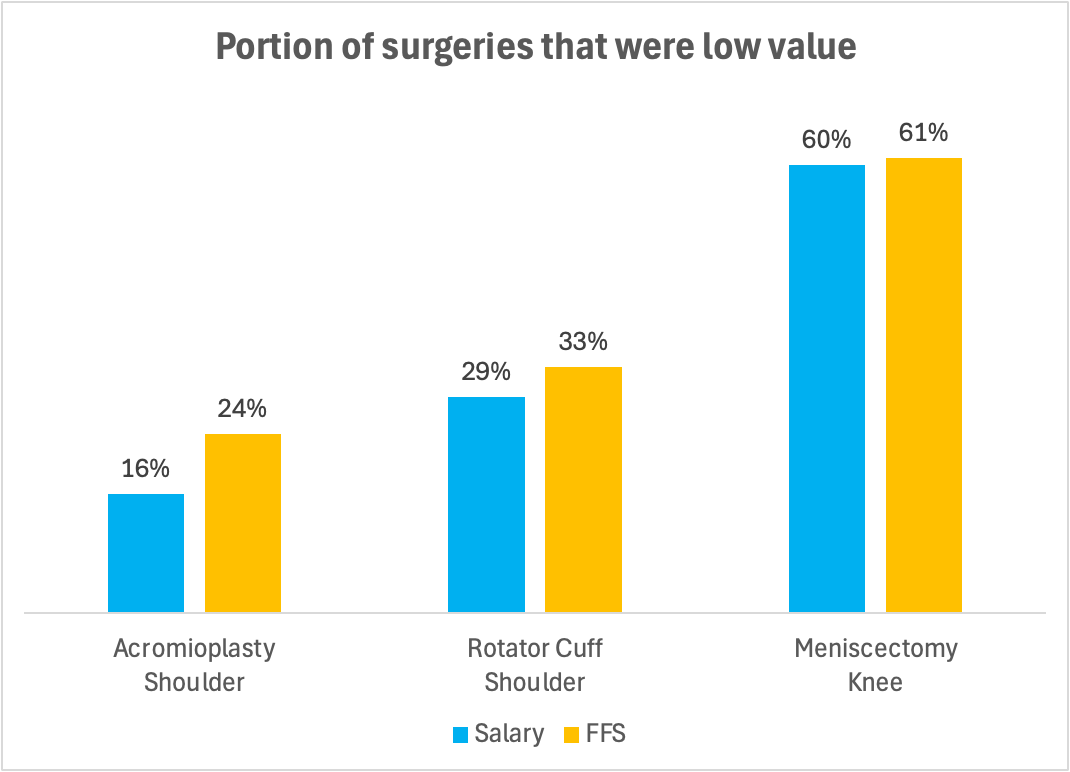
Source: Schoenfeld AJ, et al. Surgical Low-Value Care Between Fee-For-Service and Salaried Health Care Systems. JAMA Netw Open. 2025;8(12):e254621.
Health care in the U.S. is more expensive than in other rich countries largely due to high unit prices, but we also have plenty of wasteful utilization. For instance, knee arthroscopy for those between 35-65 with meniscus irregularities has been shown to have no clinical utility - but orthopedists continue to perform this procedure.
The Choosing Wisely program, sponsored by the American Board of Internal Medicine Foundation, tried to educate physicians about low-value care, but results were modest. There are multiple reasons why physicians are likely to perform procedures that have been shown not to be clinically effective
Physicians believe their own results are superior to the results of other clinicians, or that their patients are different. (This is called “optimism bias” in behavioral economics.)
Clinicians are paid more to perform procedures than to recommend physical therapy, medical treatments, or watchful waiting.
Physicians may believe that patients feel that their concerns are taken seriously when an operation is proposed, and could worry their patients would feel that their concerns were not taken seriously if a procedure is not recommended.
They have been performing the procedures for questionable indications for a long time, and it’s difficult to change.
Researchers used data from the military health system to compare the volume of five low-value orthopedic procedures performed by salaried military physicians (13% of procedures) with those performed by fee-for-service physicians in the private sector who treat service members and their families (87%). Their research was published in JAMA Network Open. (I have not included ankle and wrist surgeries that represented only 3% of the total volume in the graphic above.)
What they found was no surprise. Surgeons in private practice receiving fee-for-service payment performed, on average, 41% more low-value procedures than the private practice surgeons. Even among the salaried physicians, 20% of these five procedures were judged to be low value. The portion of procedures found to be low value declined from the 2016-2019 period to the 2020-2023 period in both groups, but the decline was more pronounced in the salaried group.
There could have been other systematic differences that would explain some of the higher volume of low-value care for military members in the private sector. For instance, there could have been capacity constraints in the military system, and those who were most motivated to obtain surgery could have been more likely to seek care in the private system.
Implications for employers:
Payment reform can help decrease provision of low value care, although most providers are reimbursed with a predominantly fee-for-service methodology within commercial insurance.
Although there is substantial concern that prior authorization has placed too many barriers in the way of care delivery, the high amount of low value services, especially knee arthroscopic surgery, suggests that there is still a role for prior authorization. Those surgeons who perform low-value surgery infrequently could be excused from prior authorization requirements.